I'm Kumaresh Bhuyan. Ten years in technology delivery, from the QA floor to the programme office. Today I run enterprise AI, GenAI and SaaS portfolios at Kreeda Labs, shipping for global brands across luxury fashion, media, FMCG and the public sector.
Client outcomes from the Kreeda Labs portfolio, and the gaming years before it.
The programme office behind an AI engineering company serving four continents: governance, reporting, capacity and risk. PMO frameworks introduced since 2022 lifted execution efficiency 23 percent and project completion 32 percent. Everything below shipped through this system.
A design team's material library had grown past a hundred thousand images with no way to search by look or texture, so finding one fabric meant hours of manual hunting. The visual search platform we shipped turned that hunt into a three-second query.
An HR team was fielding the same policy questions hundreds of times a month. Eight specialist agents now handle the routine load end to end — repetitive queries down 70 percent, and the whole system live in production within six weeks.
Season cycles move faster than traditional research ever could. We compressed trend forecasting from months of manual work into near real time, at an accuracy the client's own measurement puts at 92 percent.
A country's statistics were locked inside documents only analysts could navigate. They became a governed conversation: queries that took hours of manual search now resolve in seconds, with the auditability a public institution requires.
Two assistants where the answers have to be right: a product-guidance bot giving customers round-the-clock answers across a deep traditional knowledge domain, and an insurance support agent that removed 75 percent of a team's repetitive workload.
Four years on India's real-time multiplayer cricket games, from QA lead to end-to-end delivery owner. RCB Star Cricket hit number one on the Top Free Games chart within two days of release, and the studio's titles grew to millions of players on disciplined release trains and live operations.
Every engagement here sits under a confidentiality agreement, and I hold to them on my own site too. Sectors, problems and measured outcomes are shared; names are not. When a conversation needs specifics, references come the proper way: over email.
"Deployment is a purchase.The operating line behind every programme here.
Absorption is a project."
Quality, schedules, releases, teams, portfolios. Each level built on owning the one before it.
After a B.Tech from Siksha 'O' Anusandhan University: banking operations, then manual testing and defect tracking. The lesson that stuck: quality is a process, never an event.
Introduced structured testing that cut production issues, then standardised release workflows for a 35 percent gain in tracking accuracy.
Full delivery ownership of live games. A number-one chart title, three million players, six internal initiatives, 17 percent team efficiency gain.
Enterprise AI, GenAI and SaaS portfolios. A PMO built from scratch, 23 percent efficiency gain, executive and public-sector governance.
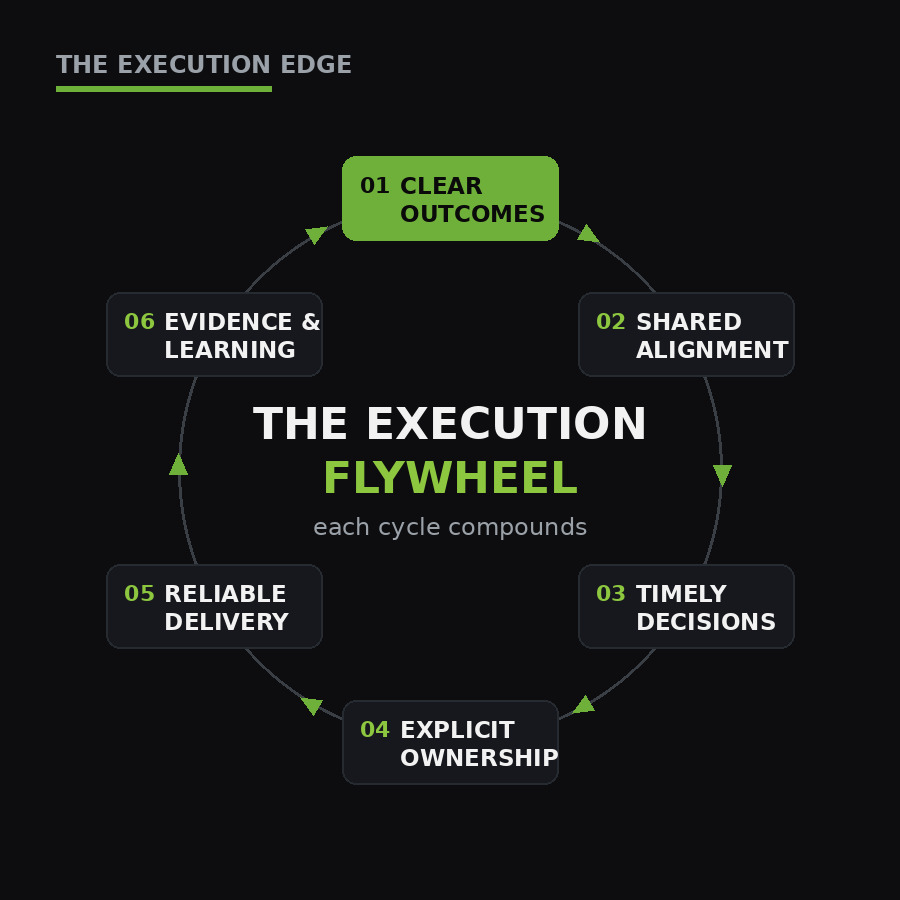
Long-form essays and The Execution Edge newsletter: what enterprise AI adoption actually takes, argued with real cases and real numbers.
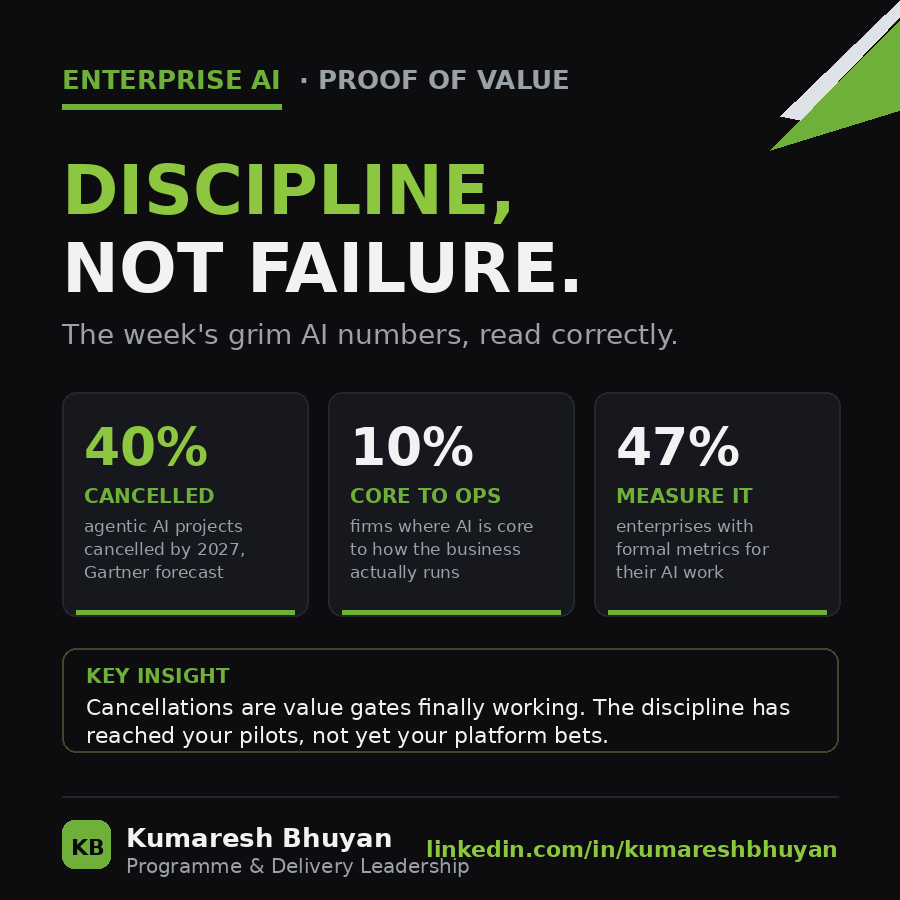
Gartner expects 40 percent of agentic AI projects cancelled by 2027, and under half of enterprises measure their AI work at all. Read correctly, that is value gates finally working: discipline has reached the pilots, not yet the platform bets.
Six quiet breakdowns disconnect strategy from delivery, illustrated with real cases: Hertz vs. Accenture, Lidl's SAP migration, Healthcare.gov, TSB Bank. Decision velocity, not delivery velocity, is the real bottleneck.
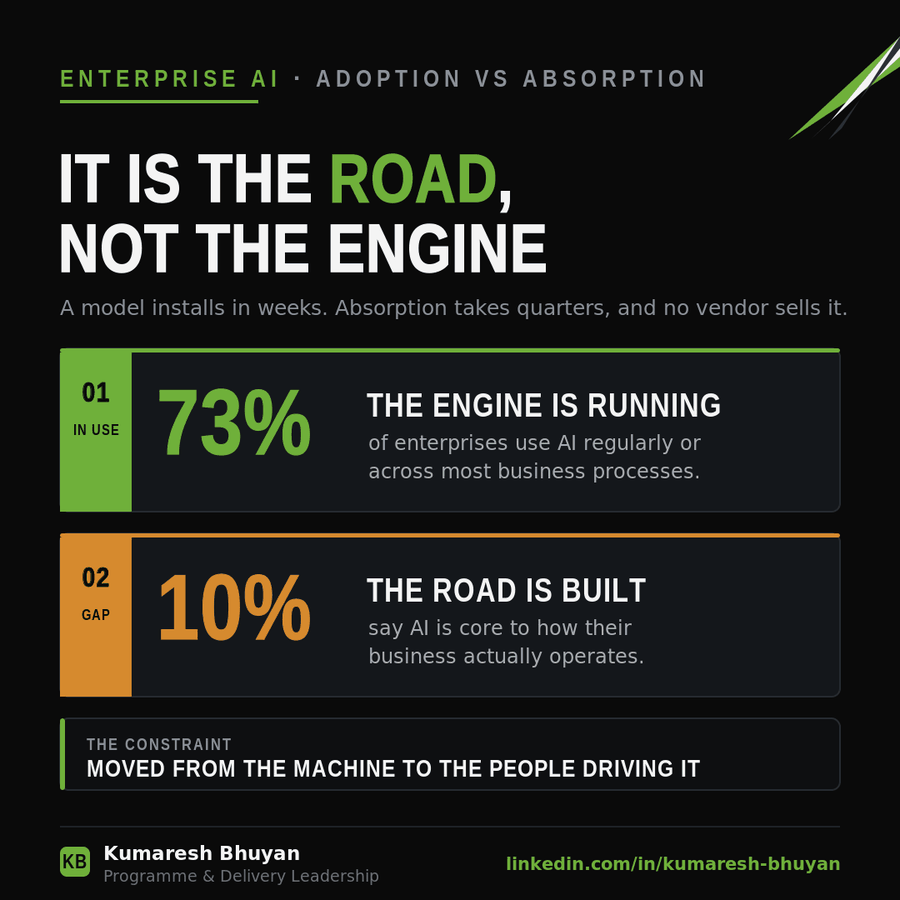
Vendor spending, a price war, a standards coalition, an adoption survey: four stories that together say the constraint has moved off the model and onto everything after it.
One deep dive a month on turning strategy into execution. Edition 01 is live; Edition 02 breaks down the framework for reliable delivery and why heroics are a symptom of a broken system.
Short operator takes on the week's enterprise AI news: what actually changed, what it costs, and what to do about it. Posted on LinkedIn most weekdays — a recent selection below.
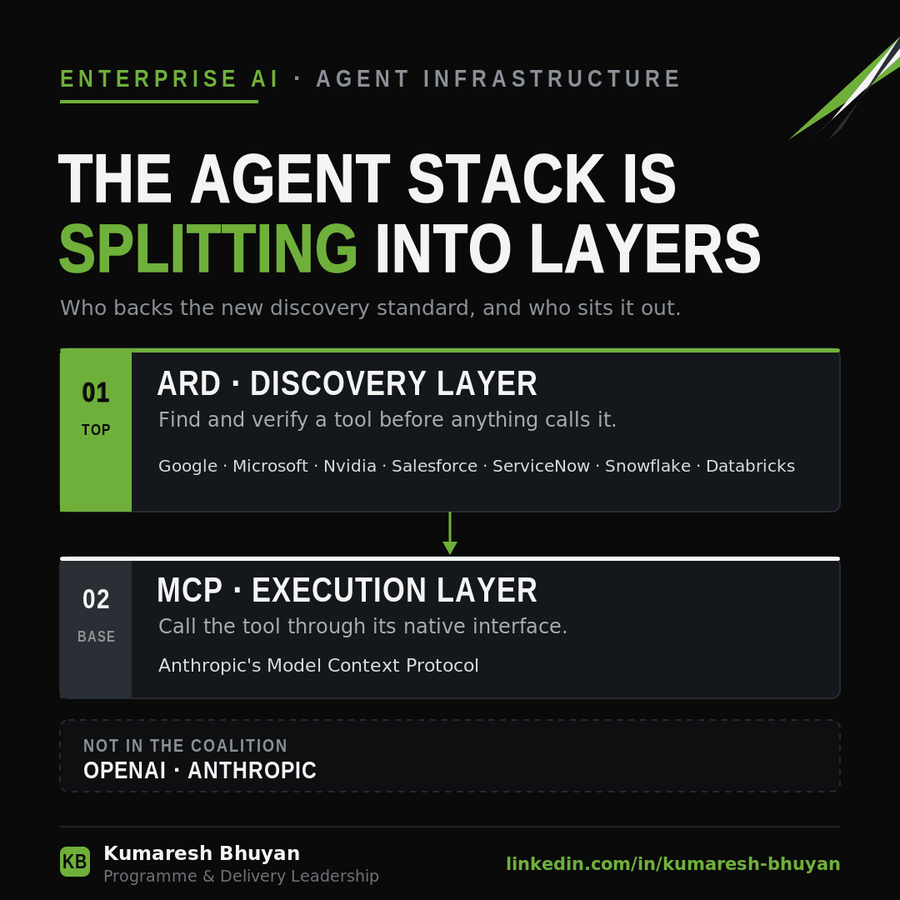
ARD sits above MCP: discovery versus execution. The interesting detail is who is not in the coalition, and why you should never bet a production stack on one vendor's protocol.
Audit rights in every contract, kill criteria agreed in advance, one named human per automated decision, everything logged. One page. No treaty required.
Twenty years of never trusting input, undone by assistants that believe everything they read. A real prompt-injection incident, and three questions for your team this week.
Microsoft, OpenAI and Anthropic are spending roughly eight billion dollars on deployment services. Nobody spends that on a solved problem. Production is where programmes stall.
Chinese-origin models now route more OpenRouter tokens than US models, at 60 to 90 percent lower cost. The spreadsheet says switch. Residency and defendability say slow down.
A new field note lands most weekdays. Following on LinkedIn is the fastest way to catch them the day they publish — and where the comment threads happen.
Global frameworks set a floor years away. These five controls protect your AI programmes this quarter. No treaty, no committee required.
Audit and evaluation rights go into every vendor contract before signing, so a model can be inspected, not just trusted.
Define the specific failure that pulls a model from production. Decide it calmly, well before any incident forces the call.
A single accountable owner for each automated decision. Accountability cannot sit with a system.
Everything the model did, and why, is recorded, so any outcome can be explained later, to a regulator or a customer.
The smallest, quietest failures get reviewed before the loud ones. That is where silent drift hides.
A designed, print-ready PDF of the checklist. Pin it to the wall, drop it in your next steering-committee deck, or send it to the team that owns your AI vendor contracts.
Download the checklistMore field notes like this are coming to my Substack. Follow along.
The rhythm: a field note most days, comments where practitioners argue, one deep dive a month. These are the lines people keep quoting back.
"Never let a plausibility engine hold the pen on anything irreversible."
Acknowledged in-thread by the post's author"Fallback logic is the easy part. A named owner for the moment of trust is the hard one."
Acknowledged in-thread by the post's author"A kill-criteria checklist at onboarding beats an entire playbook nobody re-reads."
"Most debt is created at kickoff, when the deadline locks before the dependencies are mapped."
Acknowledged in-thread by the post's author"Audit whether intake still reaches the person who saw the problem early, not just whether the model is accurate."
"A workaround nobody flagged as temporary reads like a deliberate decision six months later."
Project Management Institute · 2023
Microsoft and LinkedIn · 2023
Siksha 'O' Anusandhan University · 2011 to 2015
Enterprise AI delivery, programme leadership, or a straight conversation about what adoption takes. The inbox is open.
Where I show up in other people's comment sections.
Field reactions from real threads, not polished takes. Topics only; the rest of each conversation stays where it happened.
"It was a workaround that became load-bearing. Added under deadline pressure, the two people who understood why it existed eventually left, and nobody wanted to remove it without knowing what would break. That's the failure mode I watch for now: not the big rewrite risk, the quiet fix that outlives everyone who could explain it."
"The harder problem isn't designing the platform, it's getting a team with a working pipeline to give it up. Nobody migrates off something that ships fine just because a shared alternative exists. Whoever owns the migration usually has to make the old way visibly more expensive first, then let the new one win on its own terms."
"The real failure mode is employees who stopped raising a concern because escalation changed nothing, not the AI's blind spot. Most reviews spend their time checking if the model is accurate, and almost none ask whether the intake process still reaches the person who saw the problem early."
"We don't let a plausibility engine hold the pen on anything irreversible. That write-versus-read line almost never gets drawn at design time; it shows up only after something has already broken in production."
"The hardest issue sits before any failure-handling framework. Teams build solid fallback logic, then leave the actual call on when to trust it to whoever is in the room that week instead of to a defined owner."